Saturday, 15 March 2008

Zombie '90: Extreme Pestilence (1991)

You know, you could just substitute the entire film with this image.

It's never a good sign when an entire feature film is included as a "bonus feature" on a DVD. Andreas Schnaas second directorial effort, Zombie '90: Extreme Pestilence, is included on the Zombie Doom DVD, much like a dead rat carries the bubonic plague.

Through the wonder of stock footage, a military aircraft carries "lethal, toxic, untested chemicals" on a secret mission. Inevitably it crashes, unleashing a zombie plague. In a nearby hospital, Dr. Simon is conducting an autopsy. He extracts organs whole and unmolested from the incision... maybe that's why he died? After fighting his way a gaggle of spotty reporters, Dr. Burns (the same guy who played Dr. Senius in Zombie Doom) busts into the operating theater, and as the corpse rises from the operating table and starts playing with it's intestines, he shoots it in the head.

Dr. Burns insists that he and Dr. Simon take one of the zombie bodies back to his private laboratory so they can experiment on it in peace and maybe discover something about zombie physiology. After a gruesome autopsy, the two doctors head into the forest with a Geiger counter (played by a multimeter), don hazmat suits and gas masks and try and find the location of the aircrash.

The adventures of the two doctors are randomly punctuated by unconnected zombie attacks. A dude is cut in half by a zombie with a chainsaw, who proceeds to play around with the intestines like he's pulling taffy. A couple of zombies cut the breasts off a girl (hey Umberto, they're stealing your bit!) as she prepares to take a shower. Another girl gets her genitals mutilated, a Schnaas directorial stamp, much like Kubrick's corridor compositions. A wheelchair bound woman is decapitated with an axe and her baby (played by a doll filled with raw meat) pulled to pieces etc etc ad nauseum.

Eventually Dr. Simon is killed, and the film concludes with Dr. Burns taking an unconvincing tumble in the woods, subjecting us to a 10 minute dream sequence in an abandoned house. The whole sequence seems like an excuse to work in the location, but despite the potentially spooky surrounds, attempts at building suspense and atmosphere are woeful. During the dream he is attacked by a couple of zombies and then woken up by an actual zombie, who munches on his guts. Cue credits, which state that the film is produced by "The Violent Shitters, Hamburg". You may want to see a doctor about that, guys.

A film like this is really just a showcase for gore effects, but even they aren't particularly ambitious or creative. In most cases a guy in bad zombie makeup plays around with raw meat (rarely the appropriate cut, I saw someone pull a spinal column out of someone's stomach... very sloppy Schnaas) while being squirted with red paint. The cast is recruited from the "friends and family" school of acting. The top tier actors are those who can refrain from laughing or looking at the camera. The editing and lighting are terrible, the soundtrack consists of a few looped pieces of synthesizer twaddle.

The dub job, however, is one of the few things that makes this film watchable. That's not to say it's good; it's just so utterly bizarre. Dr. Burns (a very white German guy) is dubbed like a superfly black dude and Dr. Simon like a whiny cartoon sidekick. It's pretty obvious that most of the dialog was dubbed in off the cuff, with no attention paid to synchronising lip movement or making any sense. The film is at it's most entertaining when Dr. Burns commands his injured partner: "Don't bleed!" or says of a zombie: "Im'a run over his dick." Sometimes the film looks like it's making a genuine (if unsuccessful) attempt to build atmosphere, but then Dr. Burns sees a black, mustachioed zombie and shouts "It's Jimi Hendrix!". It's almost like watching an episode of Mystery Science Theater 3000.

It's hard to say whether this film is meant to be taken seriously, but I'm not about to give it a free pass if it's not. It sucks. In his later films, Shnaas developed a sense of humour, and his movies benefitted as a result. This film is really just a bunch of mulleted Germans playing around with a few gallons of red paint and raw meat. I'm sure it was a lot of fun, but I don't know why they had to film it.

Thursday, 13 March 2008

Story of Ricky (1991)

Q) Is this awesome? (Y/N)
A) Yes


Lik-Wong
(aka Riki-Oh, The Story of Ricky) is a film about, surprisingly enough, Ricky (Fan Siu-Wong), a man who is sentenced to prison and fights back against the bullying prisoners, the corrupt officials and the man. Not a wholly original premise, but when Ricky puts his fist through the belly of a monstrously fat prisoner, spilling a gallon of intestines and gore, you may realise that this is not your typical prison movie. In fact, this is one of the craziest, bloodiest and most outrageous films I've ever seen. It's a Hong-Kong film (one of the few films with a Category III rating and no sex), directed by Ngai Kai Lam and based on the manga Riki-Oh by Tetsuya Saruwatari. I'm not sure how faithful it is to it's source material, but since Saruwatari is the same guy who brought us The Fist of the North Star, I wouldn't be surprised if the manga contained the same level of insane ultra-violence.

Ricky used to have a happy life, flying model aircraft with his girlfriend while wearing matching yuppie outfits. One day, however, his girlfriend stumbles across a bunch of drug dealers, who chase her onto the rooftops and right off the side of a building. Seriously, she just runs right off the edge like she's in a Road Runner cartoon. Ricky immediately seeks revenge against the head gangster, punching a fist-shaped indentation in his skull. The crook shot him a bunch of times first, so you'd think that it would fall under the banner of self defence, but Ricky goes to jail anyways.

Straight away you notice that this is not your ordinary prison. As the opening crawl states, prisons have been privatised, and inevitably turned corrupt. The Assistant Warden is an obese asshole with a hook for a hand and a glass eye and what's more, they can't even afford locks on the prison doors. Hardened thugs walk around freely at all times of night and day, carrying concealed weapons and committing acts of wanton violence. It's like Cabramatta or something. The prisoners are kept in line by the Gang of Four, a group of colourful villains in cahoots with the Assistant Warden.

It's lucky then, that Ricky is a master of Chi Kung, which allows him to heal from fatal wounds and punch through torsos, which he demonstrates in short order. The Assistant Warden does not take kindly to his troublemaking. He lures him into a confrontation with Oscar, a tattooed Yakuza gangster and one of the Gang of Four. The fight goes pretty poorly for Ricky at first... Oscar sprays powdered glass into his eyeballs and cuts a deep gouge into Ricky's arm. Luckily, Ricky uses his Chi Kung powers to wash the glass out of his eyes and tie his tendons together with his bare hands. Once Oscar realises he is out of his depth, he commits seppuku with the knife and tries to strangle Ricky with his intestines. The movie only gets crazier from here.

Now, guys like Ricky and I, we're not just scowling bad asses with a propensity to put our fists through torsos, we've also got a sensitive side. He even gives a Oscar's mute godson Alan his flute (thankfully, how he smuggled it in glossed over) and in return Alan inadvertently reveals the location of the Assistant Warden's opium farm. Alan is consequently killed by the Gang of Four (Gang of Three now, I guess) and whenever a bit player dies, Ricky gives us a full-on, standing out in the rain, shaking fists at the heavens, "Nooooooo!" This happens twice in the film. Gee, dial down the drama, Ricky. Makes you wonder what he'd do if it was someone more than a passing acquaintance.

You've heard about the Assistant Warden, but what about the Warden? Well, he's been on vacation, but halfway into the film he returns with his odious, comedy-relief son. After gouging out some eyes and establishing himself as an even bigger asshole than the Assistant Warden, they set about subjecting Ricky to a series of Bond-villian-esque tortures including burying him underground for several days and filling his mouth full of razor blades. Ricky fails to crack and eventually escapes, lobotomising a dude with a single punch and popping out the Assistant Warden's good eye.

After letting the prisoners mutilate him for a while, Ricky takes the Assistant Warden to the kitchen. The Warden is doing a late night inspection and mincing a prisoner's arm in an enormous meat grinder (hm, I wonder if that will come in handy later). Unimpressed, the Warden shoots the Assistant Warden with a "compressed air" bullet, which causes him to inflate and explode. After dispatching the remainder of the Gang of Four, Ricky squares off against the Warden. The Warden has Chi Kung powers as well, but his manifest a little differently, transforming him into a hulking monster in serious need of a kleenex. After a short fight, Ricky tosses him into the meat grinder, and pulps him until there's nought left but a severed head. Holding his grisly trophy aloft to the rioting prisoners, he punches an enormous hole in the wall of the prison and informs them they are all free. I'm not saying that freeing a bunch of convicted criminals is such a hot idea, but why didn't you do that eighty five minutes ago, Ricky?

I started writing this review by cataloging all of the insane gory moments in this film, but it ended up ridiculously long. I've barely touched on all the different crazy ways Ricky pulps his enemies. This film came out about the same time as Peter Jackson's Braindead, probably the only film gorier than this one. Compared to Braindead the effects are laughably cheap, but thankfully it doesn't take itself seriously, and it's faithful to the spirit of graphically violent manga, for better or worse. I mean, the Assistant Warden stores mints in his glass eye! This film is worth watching just to see what crazy shit is around the corner, and it rarely disappoints on that front. They really don't make them like this anymore and I'll leave it up to you whether that's a good thing or not.

Sunday, 9 March 2008

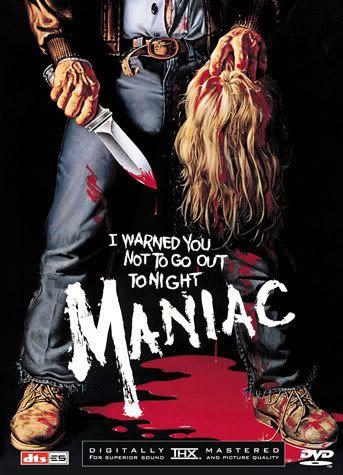
Maniac (1980)

Who could resist this sexy man?

William Lustig's Maniac is a film that seeks to shock and disturb, rather than entertain. It focuses on the last few days of serial killer Frank Zito (Joe Spinell) as he stalks and kills several women while spiraling into madness. That's it, really, so if you're looking for a complex plot then you're out of luck, and what did you expect from a movie with an awesome cover like this? (Is it just me, or does it look like the guy on the cover has a huge package?)

As the film opens, Frank Zito wakes up from a nightmare about killing a couple of canoodling teens, and from the first view of his fleabag apartment, it's clear that all is not right. Creepy dolls, some encased in cages, bizarre paintings on the wall, and a candlelit shrine to his mother. So yeah, he's not a model of sanity, and he proves so almost immediately by murdering and scalping a hooker. Back at his apartment, he nails the grisly trophy to a mannequin as he talks to it and babbles insanely.

Next he packs a some weapons into a violin case and it's off to stalk the streets of New York. Soon he comes across a couple getting busy in the back of their car, one of whom is played by none other than special effects wizard, Tom Savini (credited as "Disco Boy"!) Frank jumps onto the hood of the car, whips around the barrel of his shotgun and blasts Tom Savini's head clean off! In super slow motion! This is an amazing and memorable effect and should definitely (along with Scanners) get the Oscar nod for Best Head Explosion (a category that should be introduced asap.)

As the body count racks up, it becomes increasingly apparent that Frank has suffered terrible abuse at the hands of his mother. She used to lock him in cupboards, sleep around etc. Now he has serious abandonment issues, and his killings are a way of ensuring that the women never leave him. Not startlingly original, but it does provide a little back story for his gruesome rampage.

Eventually Frank meets a photographer in the park, Anna D'Antoni (Caroline Munro). She takes a liking to him for some strange reason, and they start dating. It shows that Frank is capable of functioning normally, even being charming on occasion, but he's not charming enough to make the idea of her being attracted to him believable. Neither of them have the acting chops to pull it off, and the scenes of them together drag terribly. Inevitably, he turns on her, but she manages to escape. As he sits in his apartment, the police closing in and his last hope for redemption severed, he finally goes off the deep end. His mannequins come to life, slowly closing in on him before gorily dismembering him with shrieks of bloodlust.

The next morning the police arrive at his apartment. His body is still intact, save a stab wound in his stomach. They are pretty lazy cops, since they don't bother checking for vitals or anything. They just shake their heads sadly and leave, cueing Frank's eyes to predictably snap open.

Maniac goes for a gritty realism, and it mostly works. It goes for a lingering sense of unease rather than a reliance on jump-scares. A scene where a girl is chased through a subway station is well staged and genuinely frightening. The synthesiser-heavy score is great and appropriately moody. Much has been made of the extreme gore in this film, and it does not disappoint. Savini's special effects are, as always, gruesomely convincing.

The film really revolves around Frank Zito (his victims are really just mannequins) and as such it hinges on Joe Spinell's performance. He put a lot of effort into preparing for this role, and he pulls it off admirably, creating a horrific yet pitiable character. Apparently Spinell stayed up all night drinking before filming in order to get the look right. I believe him. He almost always looks haggard, his face covered in a sheen of flop sweat. Much of the soundtrack consists of Frank's grunting, moaning and insane babbling. The film does an admirable job of trying to get you inside the head of a serial killer. As you can imagine, it's not a very pleasant place to be.

Saturday, 8 March 2008

Guy N. Smith Book Review - Thirst

The book opens with a lorry driver who, while driving a tanker filled with noxious weedkiller, decides to take a detour to visit his "girlfriend" - perhaps not the greatest idea at the best of times, but one in this particular instance proves to be particularly disasterous; while trying to navigate the backroads of the welsh highlands, the driver loses control and the lorry plummets into the depths of a reservoir...releasing its contents into the water supply.

This isn't just any weedkiller - but the most toxic weedkiller ever developed, and even small amounts cause horrific sympotms in its vicitms, which culminates in certain death. In fact, anyone who comes into contact with the contaminated water soon becomes a victim of the symptoms of weedkiler poisoning: unquenchable thirst, followed by maddness, copious pustules and boils over the entire body and, soon thereafter, death. And, of course, there is no antidote (well, that wouldn't be any fun now, would it?)

Now, one would have thought that in this situation the authorities might have decided to switch off the supply of water from the contaminated reservoir, but inevitably, they refuse to believe that this is a serious enough problem to warrant such action, until it can be "proven" that this is a problem (which in reality is probably not too far from what would happen in this situation!).

Well, obviously, the authorities are wrong, and pandemonium ensues when the contaminated water enters the water supply of Birmingham. The city becomes a disaster zone, people are dying in droves, and the transport system crashes to a grinding halt. No one can get out, gangs run riot on the streets pillaging houses and shops for cans and bottles to drink, and generally its not a very pleasant place to be!

Amoungst all this mayhem, we meet our main character, one of the scientists who developed the weedkiller recipie, and who for some reason feels responsible for the disaster and for restoring order to the city. On his quest, he manages to form a relationship with another survivor (well, why not?), and to befriend an axe-murderer who has just escaped from the local jail.

As far as Guy N Smith novels go, this is certainly one of the most action-packed, and anyone who delights in reading graphic and detailed descriptions of revolting medical symptoms and gruesome deaths (and lets face it, who doesn't?) will not be disappointed. I certainly delighted in the (some would argue) unnecessarily numerous description of the deaths of weedkiller victims, along with copious other large-scale diasters (huge fires which the weedkiller water is unable to put out, train and plane crashes, motorway pile-ups) which adorned the novel's pages!

Friday, 7 March 2008

I Spit on Your Grave (1978)

The hammock of the damned

Meir Zarchi's I Spit On Your Grave (otherwise known under the more tasteful title Day of the Woman) was crucified upon it's release. Roger Ebert named it the worst movie ever made, but then he liked Garfield: The Movie, so what does he know? It was finally released uncut in Australia in 2004, so I picked up a copy. Does it live up to it's reputation? Let's find out...

Successful New York writer Jennifer Hills (Camille Keaton, Buster Keaton's granddaughter!) decides to take a trip up to a remote cabin so she can finish her book in peace and tranquility. Upon her arrival, she is continually harassed by four inbred locals... Johnny (Eron Tabor), Stanley (Anthony Nichols), Andy (Gunter Kleemann) and the mildly-retarded Matthew (Richard Pace). Offended by her fancy-pants New-York-independent-feminist ways, they concoct a plan to punish her and help Matthew lose his virginity. The next day as she is relaxing on her boat, the four men tow her boat to shore and chase her through the woods. She is captured and brutally raped and beaten... twice! Bruised and bloody, she crawls back to her house, but the men are already there. They rape and beat her again and ridicule and burn her manuscript for good measure. The three men order Matthew to stab her to death, but he can't bring himself to do it and leaves her alive, concealing it from the other men.

Over the following few days, Jennifer is in a daze. Gradually she gains back her senses, and with them, a thirst for vengeance. She pieces together her manuscript and vows revenge on her attackers.

First of all, she lures Matthew to a tree near her cabin and has sex with him. When he is distracted, she slips a noose around his neck and hangs him from the tree.

Secondly, she takes Johnny back to her house and makes him strip at gunpoint. He manages to get the gun from her, but she lures him back to her cabin and into a hot bath. She starts to beat him off before pulling out a hidden knife and cutting off his wang. She locks him in the bathroom and calmly waits until he bleeds out.

The two remaining men take their motor boat to her cabin and attempt to kill her with an axe. She escapes in their boat, and as one of the men swims after her she buries the axe in his back. The last man attempts to climb onto the boat but, ignoring his pleas for mercy, she guts him with the outboard motor. The film promptly ends.

It's easy to see why this film caused a few blue-hairs to faint back in the day. The rape scene in this film is almost thirty minutes long, stark and brutal, with no muscial score or editing tricks. Not exactly pleasant viewing, and that's exactly the point. The scene isn't made to titillate. A lot of people misinterpreted this film as a glorification of rape, which makes about as much sense as saying that Catch 22 is a glorification of war. It's a harrowing experience, but it's not as morally despicable as some would have you believe.

Does it hold up after 30 years? Well, with shock-fests like Irreversible making the art-film circuit, it seems that audiences are a bit more tolerant of shocking content when it is put in an appropriate context. That's not to say it's not shocking anymore, because it is, but I doubt it would be the subject of as much controversy these days. Truth be told, a lot about this film is fairly mediocre. The men in this film are unbearably stupid. Matthew seems to be smartest out of all of them, and he's retarded. Production values are very low and the acting is spotty, although Camille Keaton is very good. This is probably one of the best films in the admittedly small rape/revenge genre, it's certainly the most well-known.

Thursday, 6 March 2008

Thriller: A Cruel Picture (1974)

You know, her aim can't be that good without any depth perception

The Swedish rape/revenge film Thriller: en grym film (Thriller: A Cruel Picture) was released in a heavily-censored form the US as They Call Her One Eye. A few years ago, Bo Arne Vibenius' revenge epic was re-released on DVD by Synapse Films in it's original cut, hardcore sex scenes and graphic violence intact.

Madeline (softcore starlet Christina Lindberg) has been left mute ever since she was brutally raped by a vagrant. She is walking near her parents' farm one day, when she is offered a ride by a passing sleazebag, Tony (Heinz Hopf). He injects her with heroin to keep her under control, and pimps her out to a variety of seedy clients, including a lecherous photographer and a violent lesbian. When she fights back against one of the clients, Tony gouges out her eye. Soon she discovers that Tony has been writing terrible letters to her parents under her name, and they have killed themselves as a result. Heartbroken, Madeline seeks out instruction from stunt drivers, martial artists and weapon specialists. Subsequently, she uses her newfound skills to wreak bloody vengeance against those who have wronged her!

Compared to grimy rape-revenge flicks like I Spit On Your Grave, Thriller has a slick and stylised feel. Scenes of violence, in particular, are very stylised, shot in Peckinpah-esque, super slow motion, with distant, echoing sound effects. The result is dislocating, and occasionally quite beautiful, such as when Madeline punches a policeman and a spurt of blood arcs gracefully across the screen. Some scenes are quite brutal and graphic, such as when Tony cuts out Madeline's eye (legend has it that they used a human cadaver).

Christina Lindberg is, as always, a treat to look at. She spends a sizable portion of the film nude, but a body double was used during the hardcore sex scenes. During her acts of revenge, she wears colourful, spaghetti-western inspired outfits with matching eyepatches, providing the inspiration for Daryl Harrah's character Elle Driver in Kill Bill (you didn't think Tarantino had an original thought, did you?)

The stylised, slow-motion violence and some beautiful shot composition (some of the frames I'd be happy to hang on my wall, only some mind you) give Thriller a classier edge, and while it's certainly not high art, it's less likely to make you feel in need of a hot bath afterwards.

Tuesday, 4 March 2008

Last House on the Left (1972)

Worst camping trip ever!

Over 30 years after it's release, critical opinion is still divided over Last House of the Left. It's fans defend it as a harrowing study of violence, while it's critics dismiss it as exploitative trash. The truth is, it probably falls somewhere in the middle.

The plot of Last House on the Left is essentially a retelling of Ingmar Bergman's Virgin Spring. Mari (Sandra Cassel) and Phyllis (Lucy Grantham) are two happy, middle-class teenagers heading to a rock concert. It's Mari's birthday and boy does she like talking about her breasts. After a discussion of boob-accentuating sweaters with her parents, she launches into a celebration of her newly-developed breasts with her best friend. My wife informs me that discussions of this nature are atypical, which left me deeply disappointed.

In an attempt to score some grass they are abducted by a foursome of escaped convicts. They consist of the ferocious Krug (David Hess), his girl Sadie (Jeramie Rain), the knife-toting Weasel (Fred J Lincoln) and the heroin-addicted Junior (Marc Sheffler). The girls are bundled into their car and taken out to the woods near Mari's house where they are teased and tormented before being raped and killed.

Following this, the convicts seek refuge at a nearby house, not realising that it belongs to Mari's parents John (Gaylord St James) and Estelle (Cynthia Carr). During the night Estelle overhears them talking about their crime, and the parents decide to take matters into their own hands.

The scenes of sexual torment are broken up by a pathetic comedy subplot about two idiotic small-town cops (one of whom is played by Martin "Sweep the Leg" Kove) and Mari's parents preparing for her birthday. I imagine the juxtaposition was intentional, but the shifts in tone are clunky and awkward. The twangy, upbeat soundtrack (partially composed and sung by David Hess) is bizarre and often highly inappropriate.

The quality of the acting varies (most of the cast were in adult film), but David Hess gives a standout performance as Krug. He would go on to play a very similar role in Ruggero Deodato's House on the Edge of the Park. Cassel and Grantham are convincing in their roles as the two victims, and according to interviews they were genuinely terrified of Hess. When they are forced to strip in the woods, Phyllis tries to comfort Mari by saying "There's no-one else here, just you and me", a heartbreaking line which I was surprised to find out was improvised. The film takes a downturn during the last act of the film. The class warfare set up between Mari's parents and the convicts is never really explored, and seeing Gaylord St James running around with a chainsaw is frankly hilarious.

There is a small amount of gore (Phyllis is disembowelled at one point) but, like Tobe Hooper's Texas Chainsaw Massacre, the real horror comes from the inhuman cruelty forced upon the girls. It may have been the subject of controversy when it was released, but Last House on the Left can't be so easily dismissed as an exploitation film. It's apparent that Craven and Cunningham were trying to strip away the veneer of slick Hollywood violence. Fans of Scream or Nightmare on Elm Street might be shocked by the raw brutality of Wes Craven's first feature. It's sloppily made, and Wes Craven is quick to admit that he had no idea what he was doing, but it's evidence of the talent that would grow in their later careers.